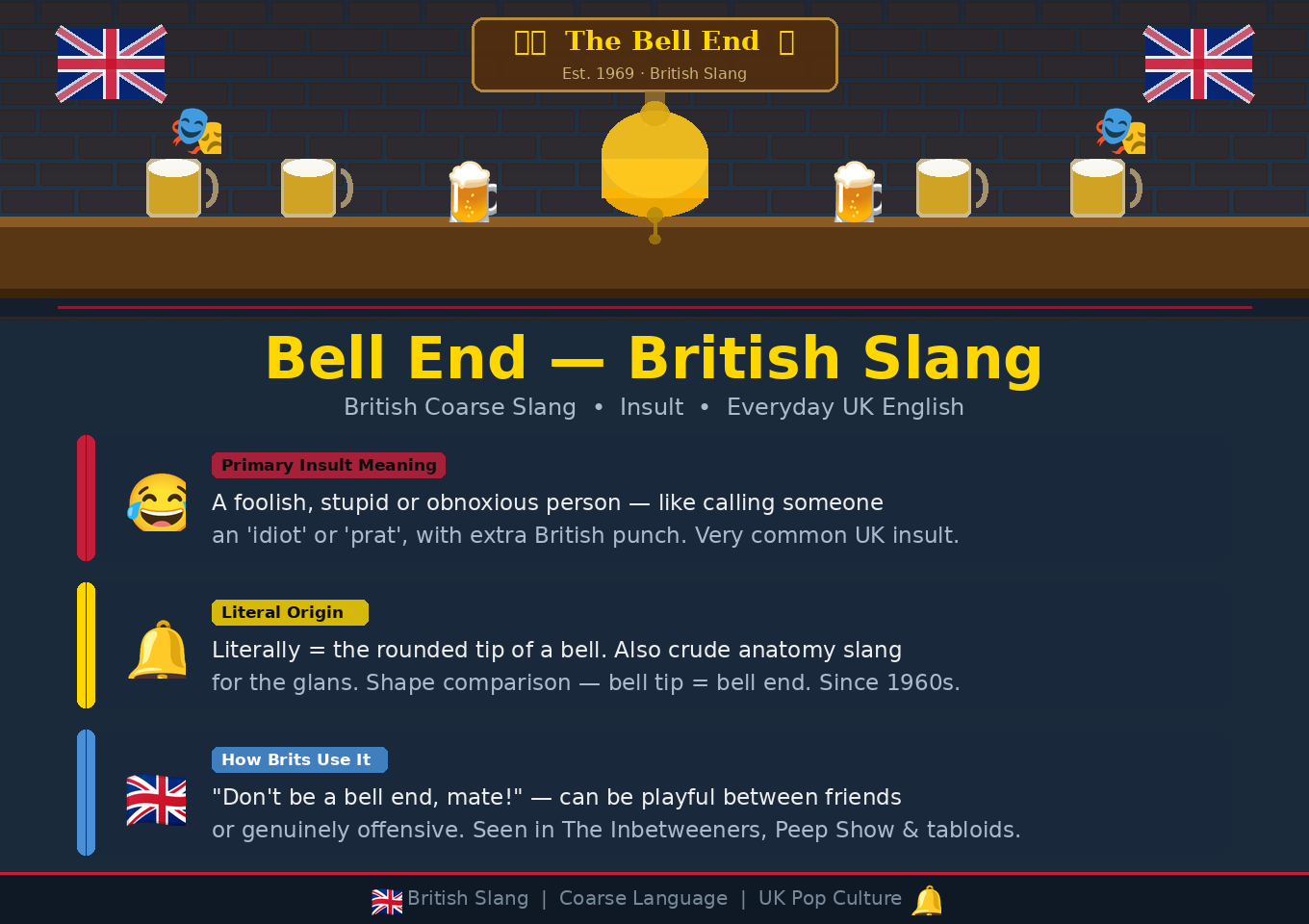
In British slang, the phrase bell end meaning British is often searched by people trying to understand what this unusual and slightly rude expression actually means. It is a common insult in the UK, frequently heard in casual conversations, comedy shows, and social media banter. While it may sound confusing or even harmless at first, the phrase carries a clearly negative meaning in everyday usage.
In simple terms, “bell end” is a British slang insult used to describe someone who is being stupid, annoying, or behaving foolishly. It can also refer to the anatomical shape it originally comes from, but in modern language, it is mostly used as a humorous or offensive way to call someone an idiot. This article breaks down the bell end meaning British usage, its origin, cultural context, and how it is commonly used today.
What Does Bell End Mean in British Slang
Literal meaning behind the term
The phrase “bell end” originally refers to the rounded tip of certain objects, but it is most commonly associated with a vulgar anatomical reference. In British slang, however, the literal meaning is not usually the focus. Instead, the expression has evolved into a widely recognized insult used to describe someone acting foolishly or irritatingly.
When people search for bell end meaning British, they are usually trying to understand why such a strange phrase is used as an insult. The answer lies in how British slang often takes ordinary or physical terms and turns them into humorous or sarcastic insults. While the literal meaning exists, it is rarely discussed in polite conversation.
How it is used as an insult
In everyday British English, calling someone a “bell end” is a way of saying they are being stupid or inconsiderate. It is stronger than calling someone silly but not as severe as more extreme swear words. Friends might use it jokingly during arguments, especially when emotions are not serious.
For example, someone might say it after a small mistake like dropping something or forgetting a simple task. The bell end meaning British usage often depends on tone—said with a laugh, it can be playful; said angrily, it becomes offensive. Context matters a lot in understanding its impact.
Level of offensiveness
Although “bell end” is considered a swear word in the UK, it is generally viewed as mid-level profanity. It is not appropriate in formal settings, workplaces, or polite conversation, but it is common in casual speech among adults. Many British comedy shows and online creators use it for humor because it sounds less harsh than stronger insults.
Still, the bell end meaning British slang should not be used lightly in unfamiliar company, as it can still offend people depending on tone and context.
Origin and Cultural Context of Bell End
Evolution of British slang
British slang has a long history of turning everyday words into creative insults. The term “bell end” follows this pattern, combining humor with mild vulgarity. Over time, it became part of informal UK vocabulary, especially among younger generations and working-class communities.
Understanding the bell end meaning British expression also requires understanding how flexible British slang is. Many insults in the UK are not meant to be deeply harmful but are instead used for expressive frustration or comedic effect. This makes terms like “bell end” widely recognizable across the country.
Influence of media and comedy
British television, stand-up comedy, and internet culture have played a major role in spreading the use of “bell end.” Comedians often use it in sketches or routines because it sounds absurd yet effective as an insult. This exposure has made the term familiar even to people who do not regularly use slang.
When people search for bell end meaning British, they often encounter it through memes, clips, or online discussions rather than direct conversation. Media influence has helped normalize the word in informal entertainment spaces, even though it remains inappropriate in formal contexts.
Regional usage in the UK
While “bell end” is understood across the UK, its frequency can vary by region and social group. It is more commonly heard in informal urban settings and among younger speakers. In more conservative or formal environments, people may avoid it entirely.
The bell end meaning British slang is still widely recognized nationwide, but like many British insults, its usage depends heavily on social context. Some people may use it frequently in joking environments, while others may consider it too rude for regular speech.
How and When It Is Used
Everyday conversations
In casual conversations, “bell end” is often used when someone makes a mistake or behaves carelessly. It is typically not meant to cause serious offense but to express frustration in a humorous way. Friends might say it during arguments that are not deeply personal or emotional.
The bell end meaning British usage in everyday speech shows how flexible British insults can be. They often shift between playful and offensive depending on tone. This makes the phrase common in light-hearted disagreements among friends.
Social media and online culture
On social media platforms, “bell end” is frequently used in comments, memes, and reactions. It has become part of internet slang, especially in UK-based online communities. People often use it to criticize bad behavior, poor decisions, or annoying content.
When analyzing bell end meaning British in digital culture, it becomes clear that the term has evolved beyond spoken language. It now functions as a quick, expressive reaction in online communication, often replacing longer explanations or arguments.
Politeness and social risk
Despite its popularity, “bell end” is still considered rude. It should not be used in professional environments, formal writing, or with people you do not know well. Using it incorrectly can easily cause offense, even if the intention is playful.
Understanding the bell end meaning British context is important because British humor often relies on tone and familiarity. Without that, the word can come across as disrespectful or aggressive.
Common Misunderstandings and Alternatives
Misinterpretation by non-native speakers
Non-native English speakers often find the phrase confusing because it does not directly translate into other languages. The bell end meaning British slang does not make literal sense, which leads to misunderstandings. Some may assume it refers only to an object, while others may not realize it is an insult at all.
This gap in understanding shows how culturally specific slang can be. Without context, the phrase loses its intended meaning and impact.
Softer alternatives in British English
If someone wants to express frustration without using strong language, there are several alternatives in British English. Words like “silly,” “daft,” or “idiot” are much softer and more socially acceptable in formal situations.
Compared to these, the bell end meaning British expression is more aggressive, even if still relatively mild compared to stronger swear words. Choosing the right word depends heavily on audience and setting.
Why people still use it
Despite being rude, many people continue to use “bell end” because it is expressive and often humorous. It allows speakers to vent frustration in a way that feels less serious than harsher insults. This balance between humor and offense is a key reason it remains popular.
The bell end meaning British usage continues to survive in modern slang because it fits well into informal British humor, which often embraces exaggeration and sarcasm.
FAQ
Q: What does bell end mean in British slang?
A: In British slang, “bell end” is a rude but commonly used insult that means someone is being stupid, annoying, or foolish. It can also refer to a vulgar anatomical reference, but in everyday speech, it is mainly used as a humorous or insulting term depending on context.
Q: Is bell end a serious insult?
A: It is considered mildly offensive. It is not the strongest swear word in British English, but it is still rude and should not be used in formal settings or with people you do not know well. Tone and context determine how offensive it sounds.
Q: Can friends use bell end jokingly?
A: Yes, among close friends, it is often used jokingly during light arguments or funny situations. However, even then, it depends on the relationship and how the other person perceives it.
Q: Is bell end used in formal British English?
A: No, it is strictly informal slang. It is not appropriate for professional, academic, or polite conversation.
Q: Why do British people use such slang words?
A: British slang often mixes humor with mild insult to express frustration in a less serious way. Words like “bell end” are part of a long tradition of creative and expressive informal language in the UK.
Conclusion
The phrase bell end meaning British reflects how colorful and expressive UK slang can be. While the term is considered rude, it is commonly used in informal situations to describe someone acting foolishly or irritatingly. Its meaning depends heavily on tone, context, and relationship between speakers.
From casual conversations to online humor, “bell end” has become a recognizable part of modern British slang. However, it should be used carefully, as it can still offend in the wrong setting. Understanding its meaning helps avoid confusion and ensures it is interpreted correctly in different social contexts.