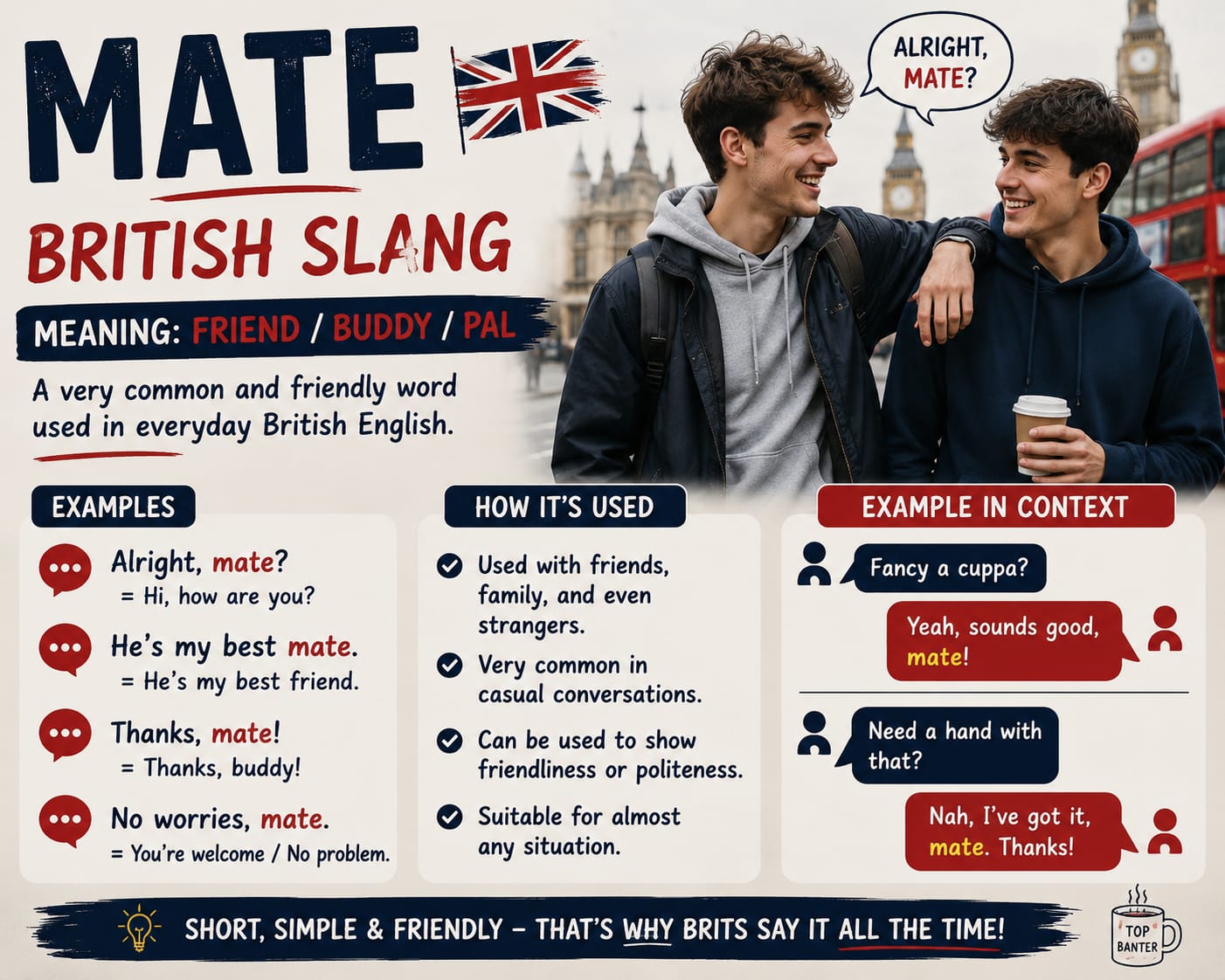
In everyday British conversation, the word “mate” is one of the most commonly heard expressions, yet its meaning can feel surprisingly flexible to non-native speakers. The phrase mate meaning British slang goes far beyond a simple dictionary definition—it reflects tone, social connection, and even subtle emotional cues depending on how it is used. In the UK, “mate” can mean friend, acquaintance, or sometimes just a casual way to address someone whose name you don’t know. It can sound friendly, neutral, or occasionally sharp depending on context.
This article breaks down the real meaning of “mate” in British slang, how people use it in daily life, and what different tones or situations it can signal. You’ll also learn how it compares to similar words like “buddy” or “pal,” and why it plays such an important role in British communication style.
What Does “Mate” Mean in British Slang?
In British English, “mate” is most commonly used to mean friend or buddy, but its usage is much broader than that. It is often used as a casual form of address, even for people you don’t personally know. For example, a shopkeeper might say, “Cheers, mate,” to a customer, or someone might call a stranger “mate” in a polite interaction.
The phrase mate meaning British slang captures this versatility. Unlike formal terms, “mate” is deeply embedded in informal speech and is used across different age groups and social settings. It can indicate friendliness, neutrality, or even mild frustration depending on tone.
“Mate” as a Friendly Address
Most commonly, “mate” is used to show friendliness or equality. It helps reduce social distance between speakers and makes interactions feel more relaxed.
For example:
- “How’s it going, mate?”
- “Cheers, mate, appreciate it.”
In these cases, “mate” functions almost like “friend,” even if the people are not close. It softens conversation and creates a casual tone, which is a key part of British social interaction.
“Mate” for Strangers
Interestingly, Brits also use “mate” when speaking to people they don’t know. This might confuse learners of English, but it is simply a cultural habit.
For example:
- “Excuse me, mate, you dropped this.”
- “You alright, mate?”
Here, it doesn’t imply friendship. Instead, it acts as a polite and neutral address, similar to “sir” or “man,” but less formal.
How and When to Use “Mate” in Conversation
Understanding mate meaning British slang also requires knowing when it is appropriate to use it. While it is widely accepted, context and tone matter significantly. The same word can sound warm, sarcastic, or even confrontational depending on how it is delivered.
Casual Everyday Conversations
In most informal settings, “mate” is completely normal and widely accepted. Friends, colleagues, and even strangers use it frequently in the UK.
Typical examples include:
- Greeting someone: “Alright, mate?”
- Saying thanks: “Cheers, mate.”
- Asking for help: “Can you give me a hand, mate?”
It helps make conversations feel relaxed and friendly. In workplaces with informal cultures, especially retail or service industries, “mate” is often used naturally between staff and customers.
Situations Where “Mate” Feels Natural
There are certain environments where using “mate” feels especially common:
- Pubs and social gatherings
- Sports events
- Casual workplaces
- Street conversations or quick interactions
In these environments, using “mate” helps maintain a friendly and approachable tone.
When to Be Careful Using “Mate”
Although widely used, “mate” may not always be appropriate. In very formal settings, such as business meetings, interviews, or official communication, it may sound too casual.
For example:
- Avoid: “Thanks, mate” in a formal email
- Better: “Thank you for your assistance”
Understanding social boundaries is key to using British slang correctly. While mate meaning British slang is generally friendly, tone and setting determine its appropriateness.
Tone and Hidden Meanings Behind “Mate”
One of the most interesting aspects of “mate” is how much meaning it can carry through tone alone. The word itself is simple, but the way it is spoken can completely change its interpretation.
Friendly Tone vs Irritated Tone
When said warmly, “mate” builds connection:
- “No problem, mate!”
But when said sharply, it can signal irritation:
- “What do you think you’re doing, mate?”
In the second example, “mate” is not friendly at all—it can sound like a warning or challenge. This contrast is a key part of understanding mate meaning British slang in real-life conversations.
Sarcasm and Humor
British humor often relies on subtle sarcasm, and “mate” is frequently part of it. Friends might use it jokingly when teasing each other.
For example:
- “Nice shot, mate…” (after someone misses badly in sports)
Here, tone and context make it clear the meaning is humorous, not literal praise.
Social Equality and Softening Speech
“Mate” also helps reduce tension in conversations. It makes requests sound less demanding and disagreements less aggressive.
For instance:
- “Listen, mate, I think you’re wrong about that.”
Even in disagreement, adding “mate” softens the impact and keeps the tone civil.
“Mate” vs Other English Slang Words
To fully understand mate meaning British slang, it helps to compare it with similar informal words used in English-speaking countries.
Mate vs Buddy vs Pal
These terms are similar but differ by region and tone:
- Mate (UK/Australia): Very common, versatile, neutral to friendly
- Buddy (US): Friendly, slightly more playful or childish
- Pal (UK/US): Old-fashioned, sometimes used sarcastically
“Mate” stands out because it is used in both friendly and neutral contexts without sounding overly emotional.
British vs American Usage
In American English, “mate” is rarely used except in specific contexts (like talking about animals or in Australian references). Instead, Americans prefer:
- “man”
- “dude”
- “bro”
- “friend”
However, in British English, “mate” is far more universal and socially acceptable across different age groups.
UK vs Australia Usage
Interestingly, “mate” is also extremely common in Australian English. In fact, Australians may use it even more frequently than Brits. However, the tone can feel slightly more upbeat or exaggerated in Australia compared to the more varied emotional tone in the UK.
Cultural Importance of “Mate” in British Speech
The word “mate” is more than just slang—it reflects British communication style as a whole. British English often values politeness, understatement, and emotional balance, and “mate” fits perfectly into that structure.
Building Informal Social Bonds
Using “mate” helps create instant familiarity between people. It removes social barriers and makes interactions smoother, especially in public spaces where people might otherwise remain distant.
A Reflection of British Informality
Even though British society can be formal in certain settings, everyday speech is often relaxed. Words like “mate” show how quickly communication can shift from formal to informal depending on context.
Everyday Identity in Language
For many people in the UK, saying “mate” is almost automatic. It becomes part of identity and speech rhythm, not something consciously thought about. That’s why understanding mate meaning British slang is essential for anyone trying to grasp real-life British English.
FAQs About “Mate” Meaning in British Slang
Q: What does “mate” mean in British slang?
“Mate” in British slang generally means friend, buddy, or a casual way to address someone. It can be used for both friends and strangers depending on tone. It is one of the most common informal words in UK English and is used to create a friendly or neutral interaction.
Q: Is it rude to call someone “mate” in the UK?
No, it is not usually rude. However, tone matters. In a friendly tone, it is polite and casual. In a sharp or aggressive tone, it can sound confrontational. Context is important when interpreting whether it is respectful or not.
Q: Can I call a stranger “mate” in Britain?
Yes, many people in the UK use “mate” when speaking to strangers, especially in casual environments like shops or public transport. It is often used to sound polite and approachable rather than disrespectful.
Q: Is “mate” used in formal English?
No, “mate” is considered informal slang. It is not suitable for formal writing, professional emails, or official communication. In such cases, more formal words like “sir,” “madam,” or “colleague” are preferred.
Q: What is the difference between “mate” and “friend”?
“Friend” is more literal and emotional, while “mate” is casual and often used in everyday speech. You can call someone “mate” even if you are not close friends, whereas “friend” implies a stronger personal relationship.
Conclusion
The phrase mate meaning British slang reveals how one simple word can carry a wide range of meanings in everyday English. From friendly greetings to neutral address and even sarcastic remarks, “mate” is one of the most flexible expressions in British communication. Its meaning depends heavily on tone, context, and relationship between speakers.
Whether you hear it in a pub, on the street, or in a casual conversation, “mate” is a key part of how people connect in the UK. Understanding it not only improves your language skills but also helps you better grasp British social culture and communication style.