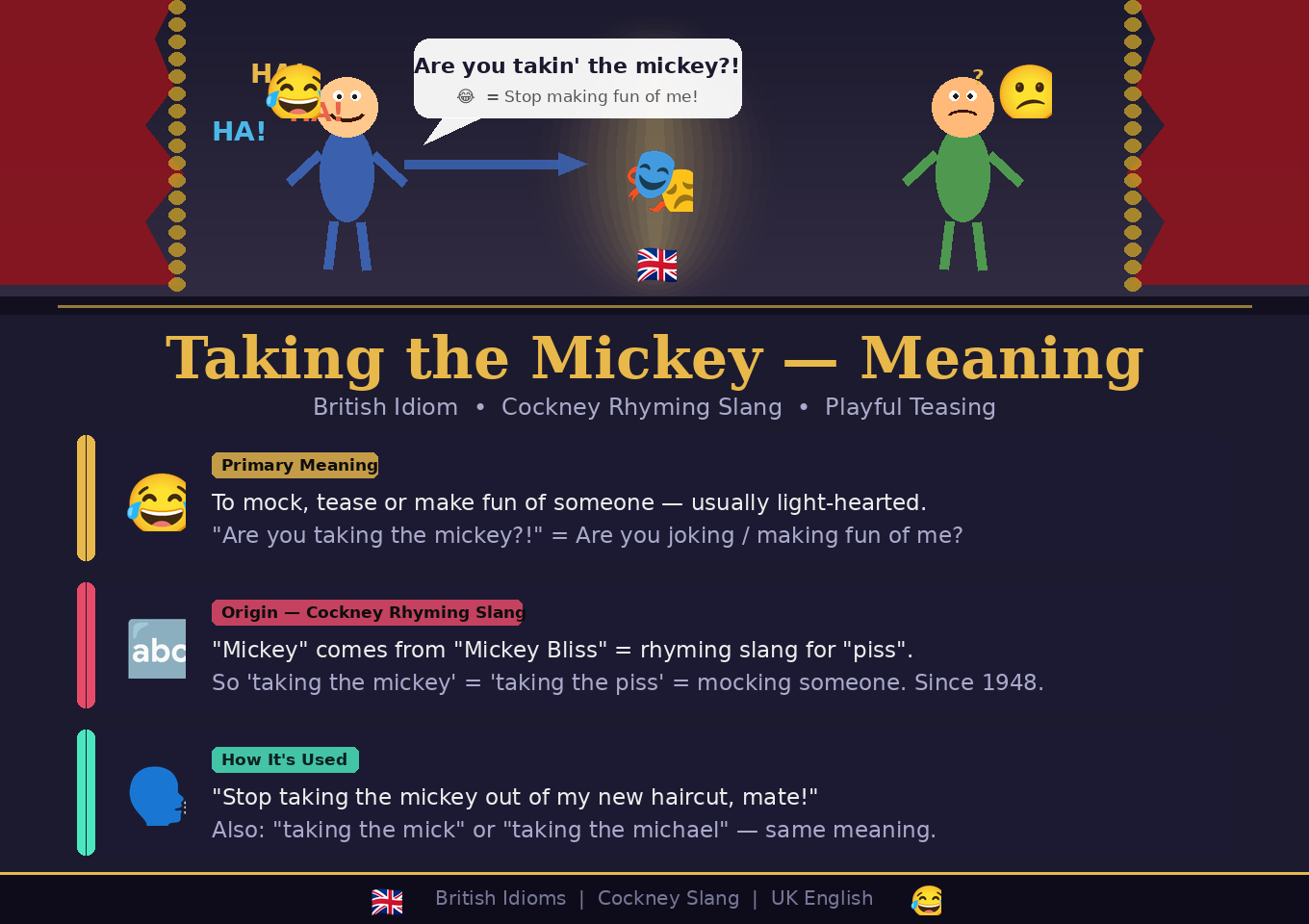
When people hear British slang like taking the mickey meaning, it often causes confusion because the phrase sounds playful but carries a very specific idea. In everyday conversation, “taking the mickey” is commonly used in the UK and other English-speaking regions to describe teasing someone or making fun of them in a light-hearted way. It is not usually meant to be harsh or offensive, although tone and context matter a lot. This article breaks down what the phrase really means, where it comes from, and how native speakers use it naturally in conversation. You’ll also see examples, related expressions, and common questions to help you fully understand it.
What Does “Taking the Mickey” Mean?
The phrase taking the mickey meaning refers to teasing someone, joking at their expense, or mocking them in a playful way. It is often shortened from “taking the mickey out of someone.” In most cases, it is not meant to be cruel. Instead, it describes friendly banter between friends, family members, or coworkers.
For example, if someone makes a small mistake and others laugh about it in a light-hearted way, they are “taking the mickey.” However, the line between joking and insulting can sometimes be thin. If the tone becomes mean-spirited, it may stop being harmless fun and start feeling disrespectful. That is why understanding context is important when interpreting the phrase.
In British English, this expression is extremely common and appears in casual speech, TV shows, and social conversations. It reflects the cultural habit of humor through teasing, which is often part of everyday interactions.
Origin of the Phrase “Taking the Mickey”
The origin of taking the mickey meaning is widely believed to come from Cockney rhyming slang. In this slang system, phrases are replaced with rhyming words or altered expressions to create coded language.
One popular explanation is that “Mickey” comes from “Mickey Bliss,” which rhymes with a crude phrase. Over time, people shortened and softened the expression into “taking the mickey.” As language evolved, the original crude reference faded, and the phrase became a harmless way of saying “teasing.”
Another theory suggests it may be related to general slang development in London English, where playful distortion of language is common. Regardless of its exact origin, the phrase has been in use for decades and is now firmly part of modern British English.
Today, most speakers use it without thinking about its historical background. It has simply become a friendly way to describe joking or teasing behavior.
How “Taking the Mickey” Is Used in Everyday English
Understanding taking the mickey meaning becomes easier when you see how it is used in real conversations. The phrase is informal and usually appears in spoken English rather than formal writing.
Friendly Banter Among Friends
Most commonly, people use the phrase during casual joking. Friends often tease each other about appearance, habits, or small mistakes.
For example:
- “Are you taking the mickey? That haircut actually looks great!”
- “Stop taking the mickey out of me for being late again.”
In these cases, the tone is playful, and everyone involved understands it is just humor.
Mild Frustration or Complaints
Sometimes, the phrase is also used when someone feels they are being unfairly teased or treated lightly.
For example:
- “I was serious, don’t take the mickey out of me.”
- “They kept changing the rules—are they taking the mickey?”
Here, it shows slight annoyance but still remains informal.
Workplace or Everyday Situations
In some workplaces, especially informal environments, colleagues may use the phrase jokingly. However, it depends heavily on workplace culture. In more professional settings, it might be considered too casual.
Even in daily life, understanding tone is important. A smile and relaxed voice usually signal humor, while a sharp tone may indicate irritation.
Similar Expressions and Variations
The phrase taking the mickey meaning is closely related to several other English expressions that carry similar ideas. These variations are often used depending on region or personal preference.
“Taking the piss”
This is a stronger British slang version with a similar meaning. It can be more offensive depending on context, though it is also used jokingly among close friends.
“Pulling someone’s leg”
This is a softer and more universally understood expression. It means joking or tricking someone in a harmless way.
“Ribbing” or “teasing”
These are more neutral words often used in both American and British English. They describe light humor without strong slang tones.
Each of these phrases overlaps in meaning, but “taking the mickey” remains distinctly British and culturally recognizable. It reflects the playful nature of informal UK English.
FAQ
Q: What does taking the mickey mean in simple words?
A: It simply means teasing or joking with someone in a playful way. It is usually not meant to hurt feelings, but to share humor between people who understand each other well.
Q: Is taking the mickey offensive?
A: Generally, it is not offensive when used in a friendly context. However, tone matters. If used harshly, it can feel disrespectful or insulting depending on the situation.
Q: Where does the phrase taking the mickey come from?
A: It is believed to come from Cockney rhyming slang in London. Over time, the expression evolved and became a common informal way to describe teasing or joking.
Q: Is taking the mickey used in American English?
A: It is mostly British slang. In American English, people are more likely to say “teasing,” “joking,” or “pulling someone’s leg.”
Q: What is the difference between taking the mickey and taking the piss?
A: “Taking the mickey” is milder and more playful, while “taking the piss” can be stronger and sometimes rude depending on context.
Conclusion
Understanding taking the mickey meaning helps you grasp an important part of British informal language. It describes playful teasing that is usually meant in good humor, though tone and context always matter. From its roots in slang culture to its everyday use in conversation, the phrase reflects how English evolves through humor and social interaction.
Whether you hear it in a TV show, among friends, or in casual speech, recognizing this expression helps you better understand natural English communication. With time, you’ll notice it often signals light-hearted fun rather than serious criticism, making it a colorful and useful part of modern slang.