If you spend any time on Twitter, TikTok, or any other social media platform, you have almost certainly seen someone post just the word “ratio” in the comments — or seen a post described as “getting ratioed.” The ratio meaning slang is one of the most distinctly internet-era terms in modern American slang, and understanding it requires understanding a very specific dynamic of social media engagement. This complete guide covers exactly what ratio means in slang, where it came from, how it is used, and what it means when someone says you got ratioed.
Ratio Meaning Slang — The Core Definition
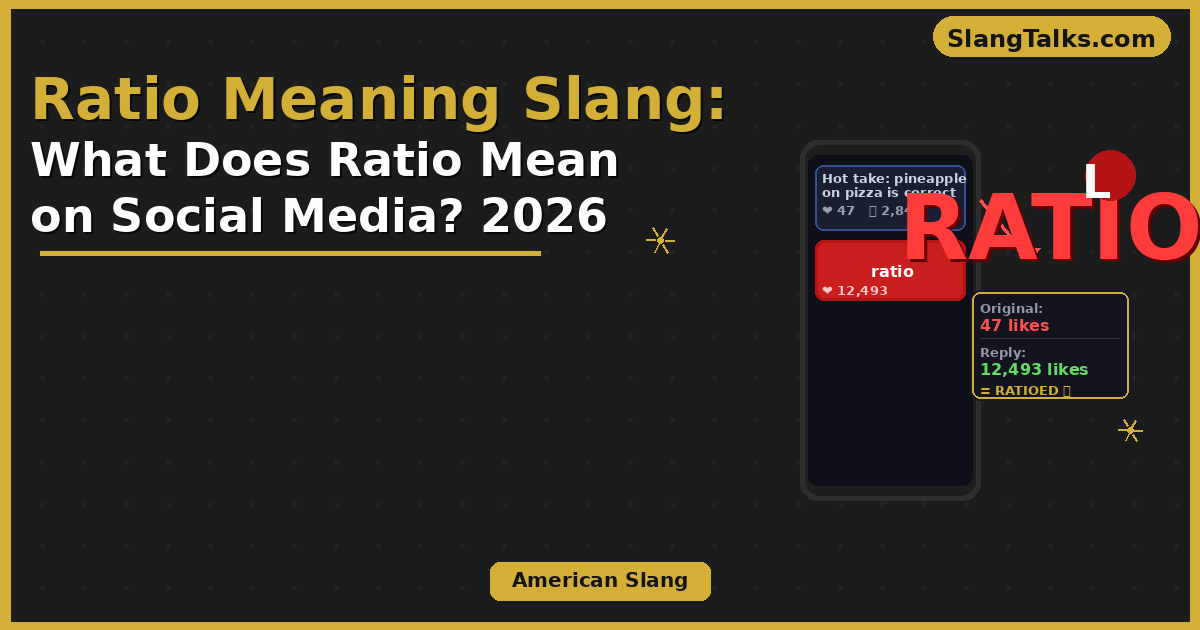
In slang, ratio (also used as a verb — “to ratio” or “getting ratioed”) means when a reply to a post gets significantly more likes, retweets, or engagement than the original post itself. On Twitter/X specifically, being “ratioed” is considered a sign that your post was widely disagreed with, criticized, or considered bad — because more people liked the reply calling you out than liked your original statement.
The ratio meaning slang in simple terms:
- Original post — gets 500 likes
- Reply criticizing it — gets 5,000 likes
- Result — the original post has been ratioed
- Meaning — the internet has collectively decided your post was wrong, bad, or embarrassing
Where Did “Ratio” Slang Come From?
The ratio meaning slang originated on Twitter — specifically from the observation that when a tweet gets far more replies than likes or retweets, it is almost always a sign that people disagree with it or find it embarrassing. Replies without likes meant people were responding but not endorsing — a reliable signal of collective disapproval.
The term gained mainstream traction around 2017-2019 as Twitter users began actively trying to ratio posts they disagreed with — posting simple one-word or one-sentence replies designed to accumulate more likes than the original tweet. “Ratio” became both a noun (describing the phenomenon) and a verb (describing the act of doing it intentionally). By the early 2020s, ratio had spread from Twitter to TikTok, Instagram, and everyday Gen Z conversation.
How Ratio Works on Different Platforms
| Platform | How Ratio Works | Sign of Being Ratioed |
|---|---|---|
| Twitter/X | Reply gets more likes than original tweet | Replies outnumber likes significantly |
| TikTok | Comment gets more likes than the video | Top comment has more likes than the post |
| YouTube | Top comment gets more likes than the video | Comment section overwhelms the video’s likes |
| Less common — comment ratio harder to track | Reply thread outperforms original post |
Ratio Meaning Slang — How to Use It
As a Noun
- “That tweet got a ratio — 200 likes and 4,000 replies.”
- “The ratio on that post is brutal.”
- “Check the ratio — people are not happy.”
- “A ratio like that means your opinion is cooked.”
As a Verb
- “We are going to ratio this post.”
- “He got absolutely ratioed for that take.”
- “Ratio him.” — a call to action in the replies
- “She ratioed that tweet with one sentence.”
As a Comment
- Posting just “ratio” as a reply — an invitation for others to like the reply over the original
- “Ratio + L + no cap” — a stacked insult combining ratio with other Gen Z slang
- “Ratio incoming” — warning that a post is about to be ratioed
Ratio + L — What Does It Mean?
You will often see “ratio + L” used together in social media comments. This combines two Gen Z slang terms:
- Ratio — your post got more negative engagement than positive
- L — short for “loss” — you lost, you failed, your opinion was wrong
Together, “ratio + L” means: your post is getting ratioed AND you are taking a loss. It is one of the most dismissive combinations in social media slang — a double takedown that signals both that your engagement numbers are bad and that your opinion was fundamentally incorrect or embarrassing. Some people add further terms like “no cap” (no lie, seriously) to emphasize they genuinely mean it.
Getting Ratioed — What Does It Feel Like?
Being ratioed is considered one of the most embarrassing things that can happen on social media — particularly on Twitter/X. A ratio signals:
- Your opinion was widely disagreed with
- Someone else’s response to you was considered better than your original post
- The internet collectively decided you were wrong
- Your post gained more attention for being bad than it would have for being good
Celebrities, politicians, companies, and public figures regularly get ratioed when they post controversial or poorly received content. Some of the most famous ratio moments in social media history have involved major brands and celebrities getting their replies flooded with criticism that far outperformed the original post in engagement.
Ratio Meaning Slang — Related Terms
| Term | Meaning |
|---|---|
| Ratio | Reply outperforming the original post in likes/engagement |
| Ratioed | Past tense — your post got ratioed |
| L | Short for loss — you lost/failed |
| W | Short for win — opposite of L |
| Ratio + L | You got ratioed AND you took a loss — double takedown |
| Cooked | Your reputation or post is destroyed — similar energy to being ratioed |
| Caught in 4K | Called out with clear evidence — often precedes a ratio |
Frequently Asked Questions About Ratio Meaning Slang
What does ratio mean in slang?
In slang, ratio means when a reply to a social media post gets significantly more likes or engagement than the original post itself. Being ratioed is a sign of collective internet disapproval — it means more people liked the response criticizing your post than liked your post itself. The term originated on Twitter around 2017-2019 and has since spread to TikTok, YouTube, and everyday Gen Z conversation. It can be used as a noun (“that post got a ratio”), a verb (“they ratioed him”), or as a standalone comment (“ratio”) designed to invite others to like the reply over the original.
What does it mean when someone comments “ratio”?
When someone comments just the word “ratio” on a post, it is an invitation — they are asking other people to like their comment more than the original post, effectively ratioing it. It signals that the commenter disagrees with or disapproves of the original post and wants to signal that disapproval through engagement numbers. It can also simply be an observation — pointing out that the post already has a bad ratio of replies to likes — or a prediction that a ratio is coming.
Is getting ratioed always bad?
Almost always yes — in the traditional ratio meaning slang, being ratioed is a sign that your post was poorly received. However, context matters. Sometimes posts are ratioed unfairly by coordinated groups with a specific agenda rather than genuine widespread disapproval. Some social media users have also attempted to “reverse ratio” — posting something intentionally designed to be ratioed in order to generate attention. But in the vast majority of cases, a significant ratio is a reliable signal that the internet disagrees with what you posted.
Where did the ratio slang come from?
The ratio meaning slang originated on Twitter, based on the observation that tweets with far more replies than likes were almost universally unpopular posts — because people were responding to disagree rather than liking to endorse. The term emerged organically from Twitter power users around 2017-2019 and quickly became a defined piece of social media vocabulary. By the early 2020s it had spread across all platforms and became part of mainstream Gen Z slang.
What is “ratio + L + no cap”?
This is a stacked takedown comment combining three Gen Z slang terms: “ratio” (your post is getting more negative replies than positive likes), “L” (short for loss — you lost this exchange), and “no cap” (no lie — I am being completely serious about this). Together, “ratio + L + no cap” is one of the most dismissive things you can say in a social media comment section — it signals that the person is ratioed, wrong, and that the commenter means every word of it.
Ratio Meaning Slang: The Complete Picture
The ratio meaning slang captures something uniquely internet about how collective opinion is expressed online — instead of a single critic, a ratio is thousands of people independently deciding that a reply is better than the original, and the numbers making that verdict impossible to ignore. It turned a simple mathematical concept into one of the most distinctly social media forms of public disapproval available. Whether you are using it as a verb, posting it as a one-word comment, or watching a celebrity get absolutely ratioed in real time — the ratio has become one of the defining pieces of internet culture vocabulary.